
the choice to act
agency is knocking, open the door

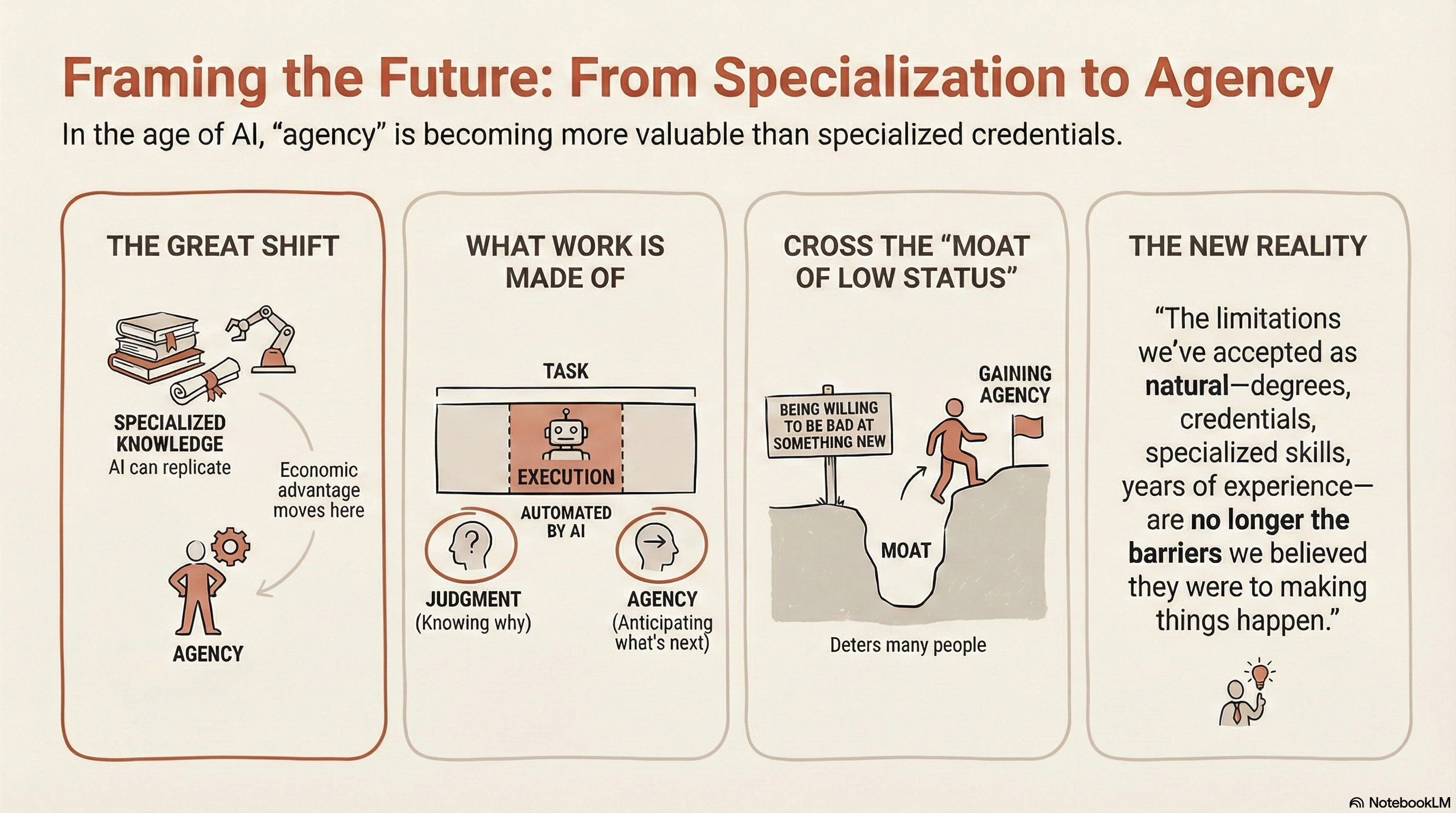
A lot of talk on the internet about agency: both the AI-software agents kind and also the take-initiative-in-life kind. LLMs and especially AI-assisted coding has helped me explore things I’ve always wanted to do, but never had the time to learn. For those for whom reading is helpful in considering new ideas, here’s a curated reading list. (Obviously, with the help of AI).
a year-old reflection on vibe-coding

Otherwise, just start building and tinkering!
Interactive NotebookLM (sign-in with Google)
PDF of NotebookLM-generated slides


Why These Readings, Why Now
Something is shifting in what it means to learn, to work, to be prepared for a world none of us can predict. The old bargain—credentials lead to specialization, specialization leads to stable career—is under pressure in ways we can all feel but struggle to name. (bonus: have the agency to look up Paul Millerd’s Pathless Path book. Lots of interviews of him on YT)
These ten pieces, written between 2023 and 2025, circle this shift from different angles. Some are practical (how to be more agentic). Some are philosophical (agency to do what?). Some are personal (escaping the high-performing robot). One is a conversation with high school students who are already living something different.
Part 1: The Shift
🔗Gian Segato — “Agency is Eating the World” April 2025 • ~10 min read
The economic argument for why agency matters more than specialization now. Segato built companies in both eras and can feel the difference.
“True agency is an unruly psychological trait. It’s the willingness to act without explicit validation, instruction, or even permission.”
“The limitations we’ve accepted as natural—degrees, credentials, specialized skills, years of experience—are no longer the barriers we believed they were to making things happen.”
What does this mean for how we credential students?
For what we tell them to optimize for?
🔗Thomas Wolf — “What Jobs Are Made Of” 2025 • ~8 min read
Thomas Wolf (co-founder of AI-model-hoster 🤗 Hugging Face) revisits a job rejection from 15 years ago and realizes the interviewer wasn’t measuring what he thought. The piece distinguishes three components of work: execution (doing tasks), judgment (knowing why tasks matter), and agency (anticipating what to do next). AI is rapidly handling execution. The other two become more important.
“In my early 20s, ‘experience’ mostly sounded like a fuzzy excuse to reject my application despite clear evidence of my capabilities and eagerness to learn.”
“The AI era may end up placing even more weight on judgment, taste, and agency—the parts of work that are hardest to specify, hardest to benchmark, and hardest to replace.”
If judgment and agency matter most, how do we cultivate them?
What does school currently optimize for?
How might we craft scenarios for students to learn how to be orchestrators/conductors as AI handles execution?
Part 2: Agency Is Learnable
🔗Cate Hall — “How to be more agentic” January 2024 • ~8 min read
Cate Hall was a Supreme Court advocate, the #1 female poker player in the world, and co-founded a pandemic medicine company—all in her 30s. She didn’t start with unusual agency; she developed it. This piece is her toolkit.
“Radical agency is about finding real edges: things you are willing to do that others aren’t, often because they’re annoying or unpleasant. These don’t always surface in awareness to the point one is actually choosing—often they live in a cloud of aversion that strategically obscures the tradeoff.”
“The moat of low status is one of my favorite concepts... making changes in your life, especially when learning new skill sets, requires you to cross a moat of low status, a period of time where you are actually bad at the thing.”
What “moats of low status” do we ask students to cross?
What moats are we avoiding as educators?
It’s doing something that doesn’t scale: meeting people 1:1 to see where they are stuck with respect to AI. First, they have to be willing to (curiosity). Second, we need the time. You know how to find me.
🔗George Mack — “High Agency” ~30 min read
The longest piece in the collection, structured like a primer. George Mack offers frameworks: the “3rd world jail cell” thought experiment (who would you call to get you out?), the tricycle model (clear thinking + bias to action + disagreeability), and five “low agency traps” (vague, midwit, attachment, rumination, overwhelm).
“You inherited a brain evolved for the scarcity of hunter-gatherer tribes. And then went through an education system designed to output factory workers for the industrial revolution. Are you expecting your default settings to be high agency?”
“If it doesn’t defy the laws of physics, it’s not an unsolvable problem—regardless of what other people say.”
Which of the low agency traps do you recognize in students? In yourself? In school structures?
🔗Cate Hall — “How to increase your surface area for luck” July 2025 • ~10 min read
A companion to Hall’s agency piece. The core insight: lucky people aren’t just lucky—they’ve arranged their lives to maximize the chances of serendipity. Concrete tactics: host events, air your weirdness publicly, give before you take.
“If you are withholding your energy for use only in those situations where you know an interaction will benefit you, you are not increasing your surface area for luck at all. You are already failing the assignment.”
“At the beginning of this process, it will feel artificial, like you’re socially flailing and trying too hard. Because you will be socially flailing, and trying too hard.”
How do we help students increase their surface area for luck?
What would that look like in school design?
Part 3: Learning Differently
These pieces challenge conventional pedagogy directly.
🔗 Zara Zhang — “To learn anything, first unlearn school” ~4 min read
The shortest and sharpest piece. Zhang argues that adult learning requires inverting everything school taught us: start with a real problem, work backwards to concepts, let motivation drive the process.
“As adults, we need to do a 180-degree reversal of how we learned as students.”
“You don’t get good and then produce output. You produce output and then get good.”
What are your own examples where you dove into something head-first, then thought about the principles?
When did you learn the principles first, then did the thing?
When did that work well?
When did that not?
What would it look like to structure student learning this way? What breaks? What becomes possible?
No matter the AI policy, there’s so much a learner (of any age) can do to learn with free LLM models. Use it to catch up or get ahead, that way the previous 🥑 avocado time ⌚(the idea that rare, ripe, in-real-life moments shouldn’t be wasted)with your instructor is well-used.
🔗 One Stone Transcript — “Student Voice and Agency” May 2023 • ~25 min read (transcript)
A conversation with Mackenzie and Ella, two high school students at One Stone School in Boise. One Stone is a nonprofit school where students sit on the board, lead admissions, design the schedule, and learn without grades. The students articulate what this feels like from the inside.
“The weight of ambition sits heavy on my shoulders.” —Ella, reframing stress as something chosen
“When you believe in us, that is the ultimate way you can show us that you care. When you hold us accountable, when you hold us to these high expectations because you know we can do it, that’s what’s really meaningful and super powerful.” —Mackenzie
What would it take to move toward this at our school? What’s one small experiment? What are the real constraints?
Part 4: The Personal Cost
🔗Cate Hall — “I used to be a high-performing robot” May 2025 • ~10 min read
A memoir of Hall’s path from dissociated achievement-machine to someone who actually chose her life. The key insight: success and agency are different axes. You can climb every ladder and still be a prisoner.
“Whatever ladder I found myself near, I climbed it. But oddly, whenever I found myself at the top of a ladder, I didn’t feel satisfied.”
“I wasn’t weighing different options and rejecting them. I just didn’t see them.”
How many of our students are on this path?
How would we even know?
What does school reward that might entrench this?
🔗Systematic Long Short — “Embrace the Warm Colors of Life” December 2025 • ~12 min read - Systematic Long Short
An anonymous author’s journey from poverty (”choosing between lunch and dinner”) to quantitative researcher to freedom. The piece argues for building a stable foundation first, then taking calculated shots. The framing is financial, but the underlying message is about agency and purpose.
“The people around me... were gray people in a world of color, and they reeked of despair and of surrender.”
“Once you see the game, you can break the stick.”
What does “escape velocity” look like for our students? What foundations do they need?
Part 5: The Counterweight
This piece complicates everything above. Include it or the collection becomes cheerleading.
🔗James Taylor Foreman — “High Agency to Do What?” August 2025 • ~10 min read
James Taylor Foreman argues that agency without direction is just force without purpose. The question isn’t how to be more agentic—it’s what your agency should serve. He distinguishes agency (the ability to do things) from destiny (the right thing to do, given your particular circumstances).
“There were plenty of high-agency individuals fighting to keep lead in gasoline.”
“Agency is a great servant, but a terrible master.”
How do we help students find direction, not just capability?
What’s the relationship between agency and ethics?
Between agency and meaning?
Once the execution becomes easier, the front-end (why) and the back-end (testing, iteration, deployment) is the focus.
Questions That Cut Across
What are we actually preparing students for?
What does school currently optimize for? What should it optimize for?
Where does agency show up in our current practice? Where is it suppressed?
What would it look like if we trusted students more?
What moats of low status are we asking students to cross? What moats are we avoiding ourselves?
What’s the relationship between agency and purpose?
Coda
These pieces aren’t the only perspectives. Several come from tech-world writers who have particular inclinations. The financial framing in “Embrace the Warm Colors” won’t land for everyone. George Mack’s piece can read as hustle culture if you squint. The One Stone model isn’t directly replicable. But that’s the whole point to spiky-points-of-views shown through essays.
What holds them together: they all take seriously the idea that how we learn, work, and create is changing, and that the old playbook isn’t enough. They disagree on specifics. That’s the point.
🏗️ start building and tinkering! 🧩
♦️ small bets, tiny experiments 🥼
I love this pathway of investigation. Thank you for pulling together great sources and sharing the notebook to both provoke and jumpstart my exploration and deep thinking.
AI doesn't replace agency. It reveals who had it all along.
The tools remove friction. What's left is intention and action.
I dig into this on my Substack about AI readiness in hospitality.